Editing the cockpit voice recording of the Hudson River landing
Close to Miracles
Summary
“It wasn't a miracle. It was a crew effort.” Thirty minutes of cockpit voice recording, set so that the order you read it in is the order it happened.
- 32 pages
- 614×861mm
- 15:00:32 → 15:30:44
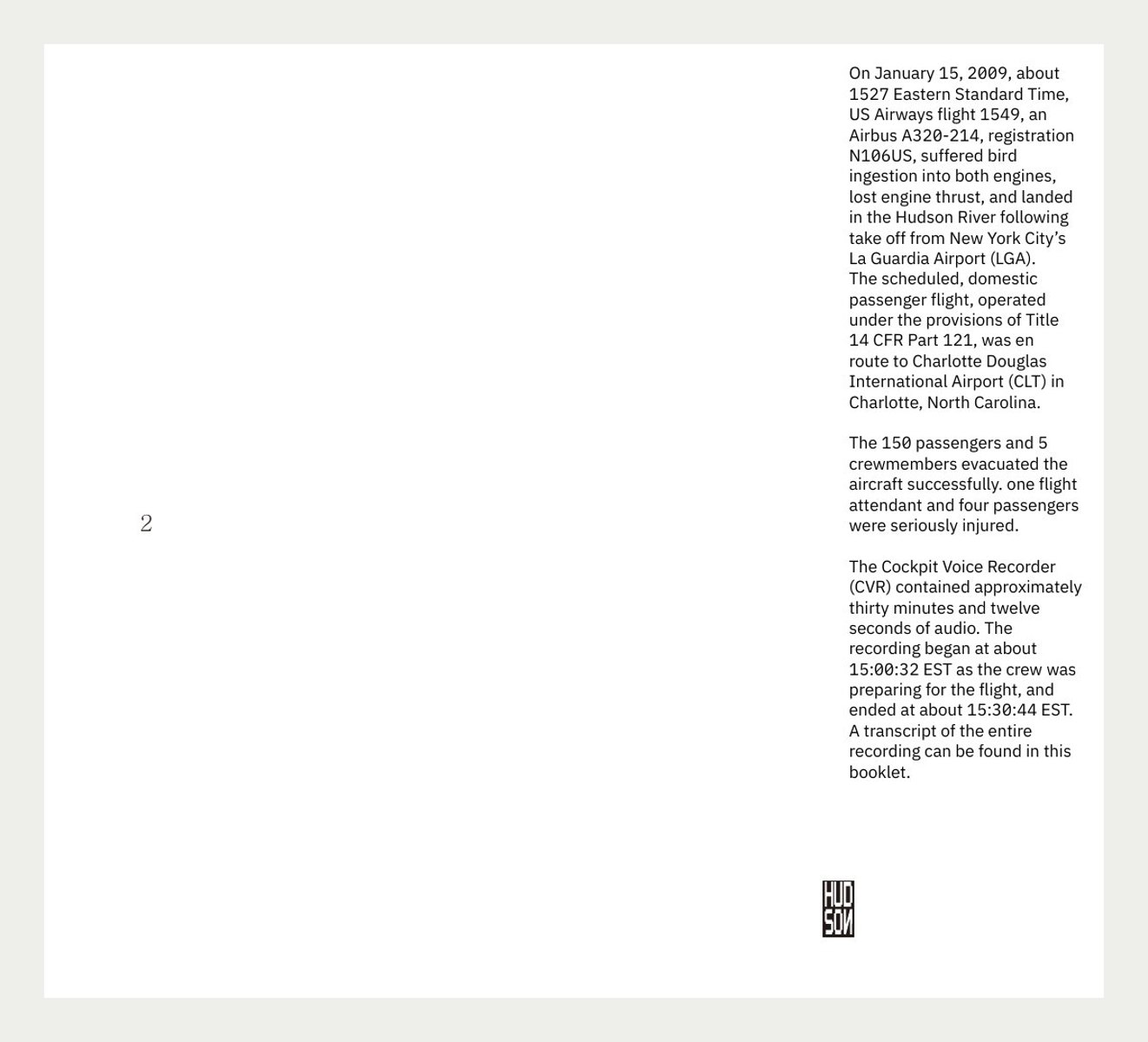
Overview
On 15 January 2009, US Airways Flight 1549 lost both engines to a bird strike shortly after take-off and landed on the Hudson River. All 150 passengers and 5 crew got out. The source text is the cockpit voice recorder transcript published by the US National Transportation Safety Board.
Editing
- The timecode is the folio — from 15:00:32 to 15:30:44, each page is numbered by the moment it holds.
- The channel is the column — inside the cockpit (HOT, CAM) against radio traffic (RDO, INTR), automatic warnings (GPWS) and cabin announcements (PA), so who spoke to whom is visible before it is read.
- One typeface family — IBM Plex Mono for the transcript, IBM Plex Sans for titles and notes. Because every utterance is set in the same width, silence and overlapping speech become space.
- The poster holds it all at once — the entire transcript on a single 614×861mm sheet, so the accident can be seen whole, rather than read in sequence.
Reflection
- Editing is interpretation. Without changing a sentence, what becomes a column and what becomes a folio decides how it is understood.
- Left undone — a few working markers from the poster's automated typesetting are still in the file; a reprint starts by clearing those.